The Common Information Model (CIM) is not that common
The future grid depends upon trusted information flowing seamlessly between systems, organisations, and markets. CIM was created to enable that vision but the reality is considerably more complicated.



Introduction: the origins of CIM – a vision ahead of its time
For more than three decades, the Common Information Model (CIM) has been presented as one of the cornerstones of interoperability within the power industry. Emerging from the need to create a common language for increasingly complex electrical networks, CIM promised a future where utilities, software vendors, system operators, and equipment manufacturers could exchange information seamlessly, regardless of the underlying technologies or proprietary systems involved.
The vision was compelling. As power systems became more interconnected and digitalised, the industry recognised that data silos would eventually become a significant barrier to operational efficiency. CIM, formalised through the IEC 61970, IEC 61968, and later IEC 62325 standards, sought to address this challenge by providing a standardised semantic model capable of describing network assets, operational states, market interactions, and business processes in a consistent manner.
On paper, the concept appears almost self-evident. If every system speaks the same language, interoperability should become straightforward. Network models should be portable. Integrations should become simpler. Vendor lock-in should diminish. Digital transformation should accelerate.
Yet, despite the maturity of the standards and decades of industry effort, the reality is far more nuanced.
The CIM paradox: Common in name, fragmented in practice
Today, CIM is widely recognised across the power sector and frequently referenced in procurement specifications, regulatory frameworks, interoperability roadmaps, and system architecture diagrams. Utilities routinely request CIM compliance from vendors,while software suppliers advertise CIM support as a key capability of their platforms.
At first glance, this would suggest that the industry has largely achieved the interoperability vision that CIM set out to deliver. Yet a closer examination reveals a different picture.
The challenge is not that CIM has failed; rather, it is that the industry’s practical experience with CIM has exposed a number of contradictions, limitations, and unintended consequences that continue to hinder true interoperability. The following paradoxes illustrate why a standard designed to create a common language has, in many cases, resulted in fragmented implementations, complex integrations, and persistent engineering effort.
Paradox #1: Everybody uses CIM, but nobody uses the same CIM
One of the most common assumptions within the industry is that CIM compliance automatically translates into interoperability. In reality, this is rarely the case. Over the past three decades, CIM has continuously evolved, introducing new classes, profiles, and implementation guidelines to address emerging grid requirements. As a result, utilities, vendors, system operators, and software platforms often implement different versions, subsets, or interpretations ofthe standard. Two systems may both claim CIM compliance while supporting entirely different profiles, object models, or exchange mechanisms. The consequence is a paradox that many integration engineers know all too well: despite speaking the same language in principle, systems frequently require manual extensive mapping, transformation, and custom engineering before meaningful information can be exchanged. Compliance, it turns out, does not necessarily guarantee compatibility. Figure 1 illustrates this challenge.
Although all participating organisations claim CIM compliance, differences inversions, profiles, extensions, and implementation practices create the need for an additional translation and mapping layer before interoperability can beachieved. The resulting integration is often project-specific, requiring significant manual effort to establish and maintain, while remaining vulnerable to future system upgrades, model changes, or standard revisions.
.png)
The irony is that interoperability is eventually achieved, but only after substantial manual engineering effort. Even then, the solution is often not future-proof, asupgrades, profile changes, or new system integrations can trigger another cycle of mapping, validation, and custom development. In many cases, the common information model remains common only in principle, while interoperability itself remains a continuously evolving engineering challenge.
Paradox #2: Systems exchange data, but not necessarily meaning
One of CIM’s greatest features is its ability to standardise data structures and information exchange mechanisms across disparate systems. However, successfully exchanging information does not necessarily guarantee that the information is interpreted in the same way by all participants.
Figure 2 illustrates this challenge. The CIM message is exchanged successfully and conforms to the same information model, yet each receiving system interprets the information through its own operational, commercial, or business context. While the data itself remains unchanged, its meaning may not, creating a semantic gap that is often invisible during integration testing but can have significant implications for operational decision-making.
.png)
As the industry moves towards greater automation, digital twins, markets, andAI-assisted grid operation, semantic interoperability becomes increasingly important. The ability to exchange data is no longer sufficient; systems must also share a common understanding of that data. Otherwise, the industry risks replacing technical integration challenges with semantic ones.
Paradox #3: One grid, many realities
The power grid is often described as a single system, yet in practice it exists simultaneously in many different forms (see Figure 3 below).
.png)
A GIS specialist views the network as a collection of physical assets, geographical locations, structures, and land boundaries. A planning engineer sees the same network as a set of equivalent impedances, thermal ratings, and power flow constraints. Protection engineers focus on fault levels, relay settings, and protection zones, while market operators are primarily interested in transfer capacities, congestion limits, and commercial boundaries. Each perspective is valid, each serves a different purpose, and each represents the same physical infrastructure in a fundamentally different way.
This creates an often-overlooked challenge for CIM. While the standard aims to provide a common representation of the power system, no single model can simultaneously satisfy every stakeholder’s requirements without introducing significant complexity. Furthermore, the existence of an XML export or a GIS extract should not automatically be confused with a CIM model. A CIM model is not merely a collection of data; it is a structured semantic representation of the network and the relationships between its components. The paradox, therefore, is that while the industry seeks a common information model, the reality is that different users require different views of the same grid. Achieving interoperability is not simply about exchanging information, but about ensuring that the appropriate representation of the network is available for the task at hand.
The greatest misconception surrounding CIM is the belief that it seeks to create a single view of the network. In reality, its true value lies in enabling many different views to coexist without losing meaning in translation. The future of interoperability will not be achieved by forcing every stakeholder into the same model, but by ensuring that diverse models can communicate reliably, consistently, and at scale.
Omega suite - From information models to actionable intelligence
The paradoxes discussed so far highlight an important reality: creating a CIM model is only the first step. The true challenge lies in making that information accessible, understandable, and useful to the engineers, planners, operators, and analysts who depend upon it every day.
This is where tools such as Omega suite’s CIM Vision become increasingly important. Rather than treating CIM as a collection of XML files, CIM Vision transforms complex network models into an intuitive and navigable representation of the power system. By ingesting CIM models from multiple sources, the platform automatically generates a comprehensive asset inventory, exposing both the physical and electrical characteristics of the network in a single environment.
As illustrated in Figure 4, CIM Vision provides multiple perspectives of the same model. Network assets can be explored geographically through an interactive map-based interface, allowing users to visualise substations, lines, transformers, generators, breakers, and other network components within their real-world locations. At the same time, the platform maintains the underlying electrical relationships, enabling users to navigate network connectivity, asset dependencies, and topology structures directly from the CIM model.
.png)
The platform also provides a detailed asset-centric view, exposing the full inventory of CIM objects and their associated attributes. Engineers can quickly search, filter, and inspect equipment classes, compare model contents, and verify that critical information has been correctly represented. By bringing together geographical, topological, and asset-level information within a single interface, CIM Vision bridges the gap between complex information models and practical engineering workflows.
Most importantly, the platform enables different stakeholders to view the same network through the lens most relevant to their role. Whether the objective is understanding asset locations, analysing electrical connectivity, validating model completeness, or preparing data for downstream applications and workflows such as power flow analysis, forecasting, digital twins, or network planning, CIM Vision provides a common operational view of the model while preserving the richness and structure of the underlying CIM representation.
From static models to automated workflows
While CIM Vision provides powerful visualisation and exploration capabilities, its true value extends far beyond simply viewing network models. In many organisations, CIM models are still treated as static artefacts that are exchanged between systems, validated, and then stored until the next update cycle. However, the increasing complexity of modern power systems demands a more dynamic approach.
Within the Omega suite, CIM Vision acts as the foundation for a range of automated analytical workflows. Once a CIM model has been ingested, validated, and enriched, the information becomes immediately available to downstream applications without requiring additional data preparation or manual model conversion. The same network representation can be utilised to support power flow studies, optimal power flow analysis, forecasting services, and other advanced network applications.
As illustrated in Figure 5, CIM Vision serves as a central orchestration layer that connects network models with analytical services across the wider platform. Rather than creating separate data silos for individual applications, the CIM model becomes a shared source of truth that can be consumed consistently by multiple services. This approach reduces duplication, improves data consistency, and ensures that all analytical workflows operate on the same representation of the network.
.png)
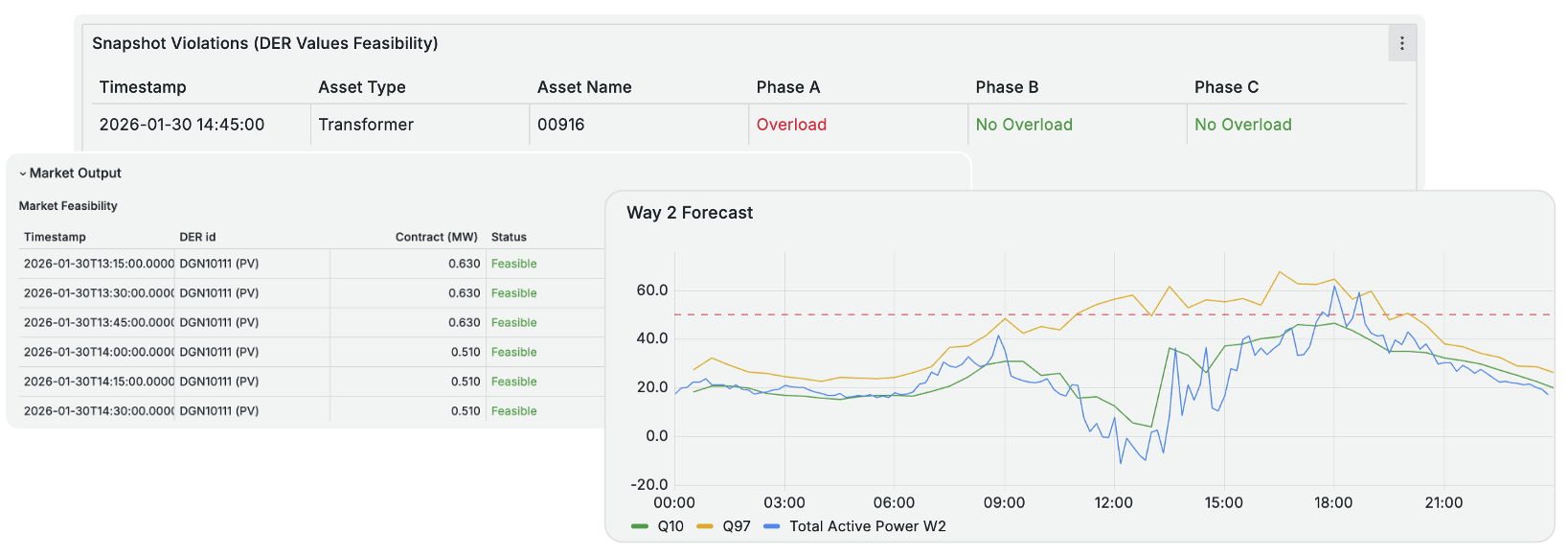
The results of these services can then be returned directly to the user through the same environment. Engineers can visualise power flow results, review optimisation outcomes, assess forecasted conditions, and investigate network constraints without leaving the platform or manually transferring information between tools. Figure 6 demonstrates how analytical outputs, including network violations, asset overloads, and market feasibility assessments, can be presented directly alongside the underlying network model.
This represents a significant shift from the traditional view of CIM as a data exchange standard. Rather than acting solely as a mechanism for interoperability, CIM becomes the digital foundation upon which automated engineering workflows can be built. In this context, CIM Vision is not simply another CIM tool; it is the platform that transforms information models into actionable operational intelligence.
Establishing a single source of truth
While CIM significantly improves the ability of utilities to exchange information, a fundamental challenge remains: most organisations do not operate a single network model. Instead, multiple representations of the same network coexist across planning, operational, geospatial, regulatory, and enterprise environments. Over time, these models inevitably diverge as assets are commissioned, network configurations evolve, and different departments maintain their own representations of the system.
As illustrated in Figure 7, CIM Vision acts as a central synchronisation platform capable of ingesting and normalising models originating from multiple sources, including planning studies, SCADA and EMS environments, GIS platforms, regulatory submissions, and other enterprise systems. Once imported, the models are mapped against common information structures based on IEC 61970, IEC 61968, and IEC 62325, enabling automated comparison and validation across previously disconnected domains.
.png)
The platform continuously analyses model content, identifying discrepancies in topology, connectivity, asset inventories, electrical parameters, operational limits, and control settings. Differences can then be reviewed, reconciled, and synchronised, creating a trusted enterprise-wide digital model that serves as a Single Source of Truth for planning, operations, analytics, regulatory reporting, and future digital twin applications.
The value of this capability became evident during a recent validation exercise performed for a UK Distribution System Operator (DSO). Using the synchronisation and comparison capabilities of CIM Vision, an assessment was conducted between a CIM v16 planning model and a CGMES/SCADA operational model representing the same network area.
Although the models described the same physical infrastructure, the automated analysis identified a number of differences in network representation, electrical parameters, operational limits, control settings, and distributed energy resource characteristics. While the specific findings cannot be disclosed for confidentiality reasons, the exercise highlighted a challenge that is becoming increasingly common across the industry: different systems may represent the same network, yet produce different analytical outcomes.
For example, differences in equipment parameters, operational constraints, or voltage control settings can lead to variations in power flow results, asset loading assessments, voltage profiles, fault level calculations, hosting capacity studies, and optimisation outcomes. As utilities increasingly rely on advanced analytics, forecasting tools, flexibility markets, digital twins, and autonomous control schemes, even relatively small inconsistencies between models can propagate into significantly different engineering conclusions and operational decisions. Facing similar challenges? Talk to us about your CIM use case.
The exercise reinforced the importance of establishing a trusted Single Source of Truth across the enterprise. Interoperability is not achieved simply because systems exchange CIM-compliant information. It is achieved when planners, operators, analysts, and market participants can rely upon a consistent representation of the network and obtain comparable results regardless of the applications being used. By continuously validating, comparing, and synchronising network models, CIM Vision helps ensure that analytical workflows are driven by trusted data rather than fragmented versions of reality.
Conclusion
More than thirty years after its inception, CIM remains one of the most important enablers of interoperability within the power industry. However, as this article has demonstrated, achieving true interoperability is about far more than exchanging standardised files. Differences in implementations, interpretations, model completeness, and data quality continue to create challenges that limit the industry’s ability to fully realise the original vision of CIM.
The challenge today is no longer establishing common information models, but ensuring that those models remain trusted, synchronised, and operationally meaningful across increasingly complex utility ecosystems. As utilities continue their digital transformation journeys, the importance of validated and governed network models will only increase.
At SMPnet, we believe that the future of CIM lies in transforming static information exchanges into living digital assets that support planning, operations, forecasting, optimisation, and digital twins. Through CIM Vision and our wider synchronisation and analytics capabilities, we are helping utilities move beyond compliance and towards a genuine Single Source of Truth. Only then can the industry fully unlock the value of CIM - and perhaps finally make the Common Information Model truly common.
Working with CIM models across multiple systems?
If model consistency, interoperability or validation is creating challenges for your organisation, talk to us about your CIM use case.
Click - Talk to us about your CIM use case
Related