

The Grid’s Missing Link: Turning Real-Time LV Data into Actionable Flexibility
SMPnet’s Omega suite proves autonomous grid control isn’t future talk—it’s already live in grids. Community DSO architecture can plug into platforms like Kraken and turn retail flex into real impact.



As the UK moves to decarbonise heat, transport, and energy, the HV and LV grids are quickly becoming the system’s first point of constraint. While investment in infrastructure is necessary, there is an equally powerful — and faster — lever available: coordination.
At SMPnet, we have now proven that it’s possible to run local grid control autonomously, in real time, on live networks. Not in simulation. Not as a digital twin. But in daily, continuous operation — predicting, dispatching, and validating results down to the feeder level.
In our trial with Northern Powergrid (NPg), we’ve embedded an autonomous orchestration layer — powered by the Omega suite — across selected LV feeders. The role we perform there is referred to as the “Community DSO”(CDSO), but the principle is broader:
Feeder-level intelligence that monitors loading, forecasts peaks, and dispatches local flexibility, with zero manual intervention leveraging integrations with aggregators to amass flexibility that LV assets could offer.
Real Impact, Real Numbers

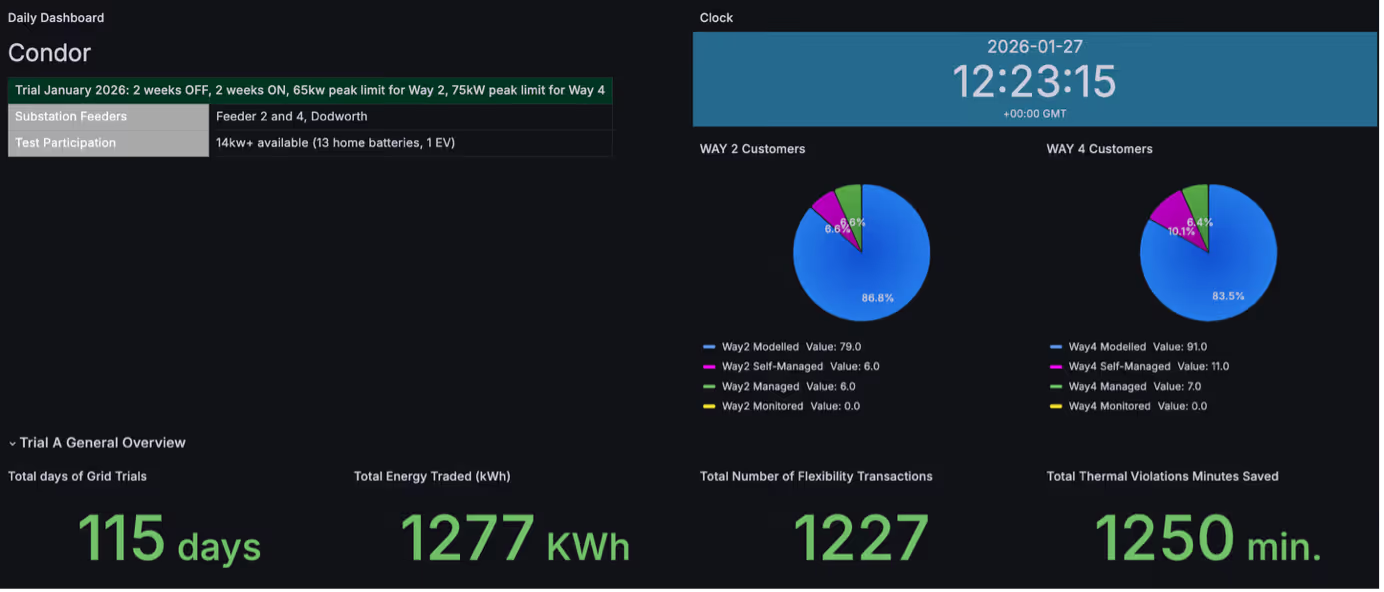
Across 115 days of end-to-end live grid operations, the Community DSO trial has delivered measurable, validated outcomes — summarised in the extract below, taken directly from our Omega suite platform:
• 1,250 minutes of thermal violations avoided through autonomous orchestration
• 1,277 kWh of local flexibility traded across residential batteries and EVs
• 1,227 flexibility transactions executed across community cells
These figures aren’t simulated estimates — they are operational outcomes, validated minute-by-minute, drawn directly from the Omega suite’s integrated analytics and reporting stack. This is what it looks like when LV data meets dispatch-grade coordination.
Full-Stack Autonomy, Live on the Grid
Through the Omega suite, SMPnet operates a complete orchestration stack
• Forecasts localised demand and threshold
• Bids flexibility into platforms like Cleanwatts and ev.energy, through NODES
• Dispatches assets with minute-level precision
• Validates grid impact against real-time telemetry
• Quantifies performance through automated reporting and counterfactual comparisons
This is the level of control required to enable electrification without reinforcing every feeder. And we do so by bringing everything together in a single easy to use dashboard:

What you see here is more than just a dashboard: it’s an end-to-end, grid orchestration interface. Unlike traditional setups where DSOs rely on multiple disconnected tools — SCADA, third-party portals, and asset-level APIs — we’ve unified it all. This single interface aggregates:
• Flexibility bids from market platforms like NODES
• Real-time household and community-level data via Cleanwatts
• EV telemetry and controls from ev.energy
• Transformer-level signals from EA Technology’s Visnet Hub
Every data stream, every control point visible and accessible through one platform.
And with role-based access control, we’ve eliminated the visibility silo. Full control remains with those cleared for SCADA-grade interaction, but everyone else — from planners to ops to comms teams — can observe, understand, and engage. That’s how we shift from centralised control to distributed intelligence without compromising security or oversight.
This platform/dashboard/suite addresses a critical blocker in most DSO environments: fragmented visibility between planning, operations, and market actors. SMPnet enables a shared source of truth across the full flexibility lifecycle — from scenario planning and forecasting to bidding, dispatch, validation, and settlement.
But visibility alone isn’t enough.
At the core of the Omega suite is an embedded PF (Power Flow) and OPF (Optimal Power Flow) engine, allowing DSOs to go beyond observing the system — and start orchestrating it. These engines continuously compute where, when, and how much flexibility is needed across the LV network. Not in batch mode. In real-time. With dispatch-grade accuracy.
This enables:
• Planners to model real-world impact and identify constraint zones before they materialise.
• Operators to issue dispatch signals based on live capacity headroom and local system constraints.
• Aggregators to receive precise flexibility requirements tied to real network conditions — not general estimates.
• All stakeholders to trace every trade, activation, or avoided cost directly back to grid outcomes.
This is what true grid coordination looks like: not just aligning humans, but aligning systems — across voltage levels, timescales, and control layers —through a unified intelligence layer.
Forecasting with Purpose — Including Informed Inaction
An overlooked but critical part of our orchestration stack is the ability to forecast when not to act.
Our Omega suite consistently predicts also low loading conditions with such accuracy that we avoid unnecessary trades; saving costs and protecting asset lifecycles. On multiple days, feeders operated just 2–6 kW below threshold, with no flexibility activated because it wasn’t needed. This is the silent intelligence behind true flexibility.
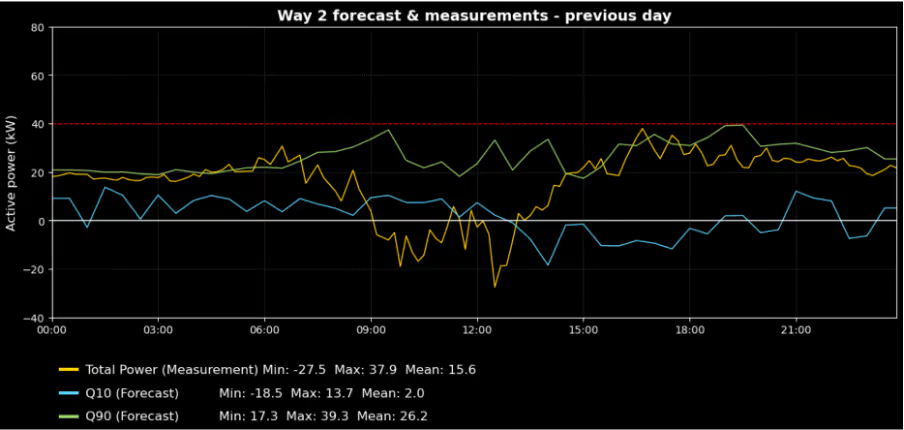
The figure above showcases the accuracy of the forecasting engine in predicting both low and high loading.
Partnerships Matter — and They Must Evolve
Today, our coordination involves integrations with Cleanwatts and ev.energy, both of whom bring specialist expertise in enabling domestic and transport-based flexibility. Through their platforms, homes and EVs are able to respond to system needs in real time, contributing to a more responsive and resilient grid.
But as we scale from feeder-level trials to wider deployment, the integration landscape needs to grow. DSOs will require deeper alignment with the software and systems already managing DERs across thousands of homes, businesses, and depots. That means unlocking interfaces with the platforms that orchestrate grid-edge devices at scale — and ensuring that grid-level optimisation logic like SMPnet’s can interact with them fluently. Together, we could close the loop from consumer action to substation stability. Flexibility becomes truly autonomous when trading and control operate in sync.
This isn’t a challenge of technology. It’s a challenge of coordination, incentives, and openness — the very themes the Community DSO project is helping illuminate.
What Comes Next?
Over the coming months, we’ll be expanding our trial within NPg’s service area to include two more communities with similar capabilities as the one currently managed. But the long-term ambition is bigger. We want to see real-time grid coordination, as enabled by the Omega suite, become a core DSO function.
That will mean:
• Scaling from pilot feeders to entire LV zones
• Scaling from targeted deployment to full-network automation across asset types
• Embedding flexibility coordination into the daily operation of substations and community nodes
We know what’s possible. We’ve seen the early results. Now, it’s about partnering with the platforms and people who can help us scale — from cells to systems, from pilots to policy.
Let’s connect the dots between real-time grid control and consumer-side flexibility — and make localised coordination the engine of the UK’s net zero future.
Related

.jpg)
.jpg)
