SMPnet provides specialist technical expertise for utilities, developers, OEMs, and large data centres operating at the forefront of grid transformation. We focus on complex, high-impact challenges where conventional approaches cannot deliver, leveraging deep knowledge in real-time control, digitalisation, and advanced power system dynamics. These capabilities deliver standalone value, enabling clients to design, validate, and operate more resilient and adaptive power systems.
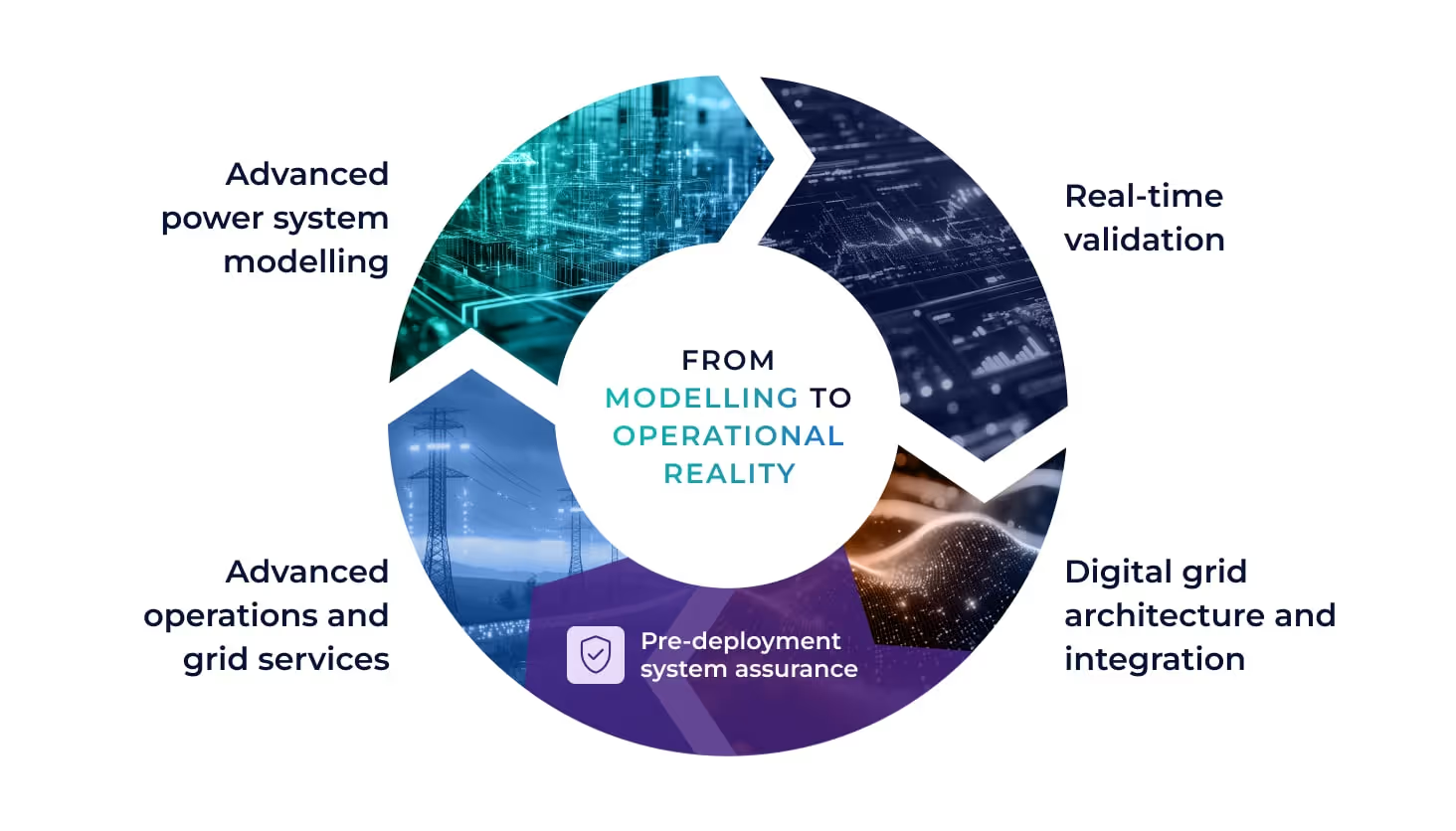
Most approaches to grid transformation stop at analysis. SMPnet connects high-fidelity modelling, real-time validation, system architecture, and operational design through to implementation.
Unlike academia-led approaches and conventional consultancies, this work is delivered at speed, with higher fidelity, and with a direct path to implementation rather than standalone reports. Drawing from our expertise on software integrations to live control room environments across the world, we offer clients higher confidence and a clear route to live operation in complex, dynamic power systems.
Engineering capabilities spanning modelling, validation, system design, and operation in complex, dynamic power systems.
High-fidelity modelling of complex, dynamic, and converter-dominated power systems.
High-fidelity modelling of complex, dynamic, and converter-dominated systems where conventional tools fall short. This includes hybrid AC/DC networks, offshore wind, interconnectors, and grid-forming or grid-following behaviour.
Industrial-grade testing using hardware-in-the-loop and real-time simulation to validate control strategies and grid behaviour.
SMPnet's Digital Grid Lab provides real-time validation of control strategies and system behaviour using hardware-in-the-loop and controller-in-the-loop environments. The lab, based in our Athens office, enables testing, iteration, and validation under complex, dynamic conditions.
End-to-end design and planning of interoperable, software-defined grid systems across control, data, and operational environments.
Design and planning of interoperable, software-defined grid systems across assets, platforms, and control environments. This includes both digitalisation and integration of legacy and next-generation systems to support the evolution of grid operational models into software-defined control environments.
Operational strategies and system service design for dynamic, decentralised power systems, integrating flexibility, market participation, and grid services optimisation.
Design of operational systems and grid service frameworks for modern power systems. This includes real-time operational design, flexibility coordination, and analysis of how distributed resources contribute to system stability and performance.
End-to-end validation ensuring systems perform as expected before live deployment.
End-to-end validation to ensure systems perform as expected before live deployment in complex power systems, reducing both technical and financial risk.