

From power-on to control: Fully automated Omega suite deployment in under 2.5 hours
Today’s grid challenges are less about what’s possible, and more about how quickly, securely, and consistently it can be deployed in the field.


As distribution networks face increasing pressure from electrification, distributed energy resources (DERs), and real-time operational demands, the ability to deploy grid-edge intelligence quickly and consistently has become critical. For Distribution System Operators (DSOs) and network operators, the challenge is isn't what to deploy, but how fast, how securely, and how reliably it can be rolled out across substations at scale.
Grid-edge deployments today must be more than robust, they have to be rapid, secure, and easily replicable across substations operating at different voltage levels. Traditional approaches are often manual, time-intensive, and prone to inconsistency between sites, slowing down the activation of new capabilities and introducing operational risk.
At SMPnet, we have developed a proven, field-tested automated deployment pipeline for the Omega suite that enables substation-grade virtual machines to go from zero to real-time control in under 2.5 hours, enabling rapid activation of grid intelligence at the substation level.
This blog takes you behind the scenes of that journey, from substation deployment to dashboards and real-time grid control, showing how the Omega suite brings digital substations to life with zero manual intervention, no configuration drift, and full operational integrity. For DSOs, this means moving from infrastructure deployment to active grid intelligence within a single operational window, with deployment, validation, and activation completed in one continuous process.
Click below for a real-time view of Omega suite deployment, showing how the platform is installed and brought into operation in practice. This short video gives a clear sense of the speed, consistency and operational readiness achieved through a fully automated approach.
Read more for an insight into SMPnet’s fully automated VM deployment, specifically designed to address the challenges DSOs are facing.
Delivering:
- Consistent, site-agnostic provisioning of all Omega suite modules
- End-to-end encrypted infrastructure bootstrapping
- Built-in validation of all system components and credentials
- Seamless scaling across substations and control rooms
Our deployment pipeline is already implemented in operational substations, running real-time optimisation and control today. The deployment process follows a streamlined automated activation sequence that brings the Omega suite platform and all core applications online without manual configuration.

Step-by-step: Omega suite’s fully automated deployment
The following sequence outlines what happens during an Omega suite deployment, based on SMPnet’s production-ready installation procedure:
1. Authenticated VM asset retrieval
Deployment begins with secure access to SMPnet’s software delivery repositories, where the deployment image and configuration assets are retrieved through authenticated channels.
2. Environment initialisation
The deployment image is launched within the target runtime environment. During initial startup:
- A secure configuration package is mounted as a virtual CD-ROM.
- The VM verifies its environment and begins auto-installation of the Omega suite.
The automated bootstrap handles all required system configuration and service initialisation.
3. Automated stack bootstrapping
Within minutes of the first boot, the VM autonomously installs all core applications:
- Aware – Forecasting & network observability
- Optisys – Grid optimisation engine
- Control – Real-time control layer
- Omega Link – Protocol Synchronisation Tool
These modules are deployed automatically from SMPnet’s secure software delivery framework. All required services and system components are initialised during the automated activation process, ensuring a consistent and validated runtime environment across deployments.
4. Secure instance validation
Before entering operational mode, the Omega suite performs an automated licensing and integrity validation step.
Each deployment instance is cryptographically bound to the unique system identifier of the runtime environment. This identifier is derived from the underlying virtualisation platform, ensuring that the Omega suite instance is tied to the specific infrastructure on which it is deployed.
This mechanism enables the platform to:
- Validate that the software is running in an authorised environment
- Prevent unauthorised duplication or cloning of deployments
- Ensure that each licensed instance corresponds to a single operational runtime
By binding the deployment to the hypervisor-level system identity rather than to network parameters, the Omega suite prevents scenarios where multiple virtual machines could be generated from a copied configuration. This guarantees that each operational instance remains uniquely validated and tightly coupled to its authorised runtime environment, eliminating the possibility of uncontrolled replication across infrastructure.
Once this verification step completes, the system transitions automatically into active operational mode. This approach ensures that a single licensed deployment cannot be replicated into multiple operational instances, protecting both system integrity and operational security.
5. Live execution & system health monitoring
With all services up, the Omega suite begins live grid execution cycles, logging every run in milliseconds. Operators can:
- Observe real-time system status
- Verify process responsiveness
- Confirm full backend orchestration
This confirms that the system is no longer in install mode, that it's running actively and ready for grid control.
6. Dashboard generation & visibility
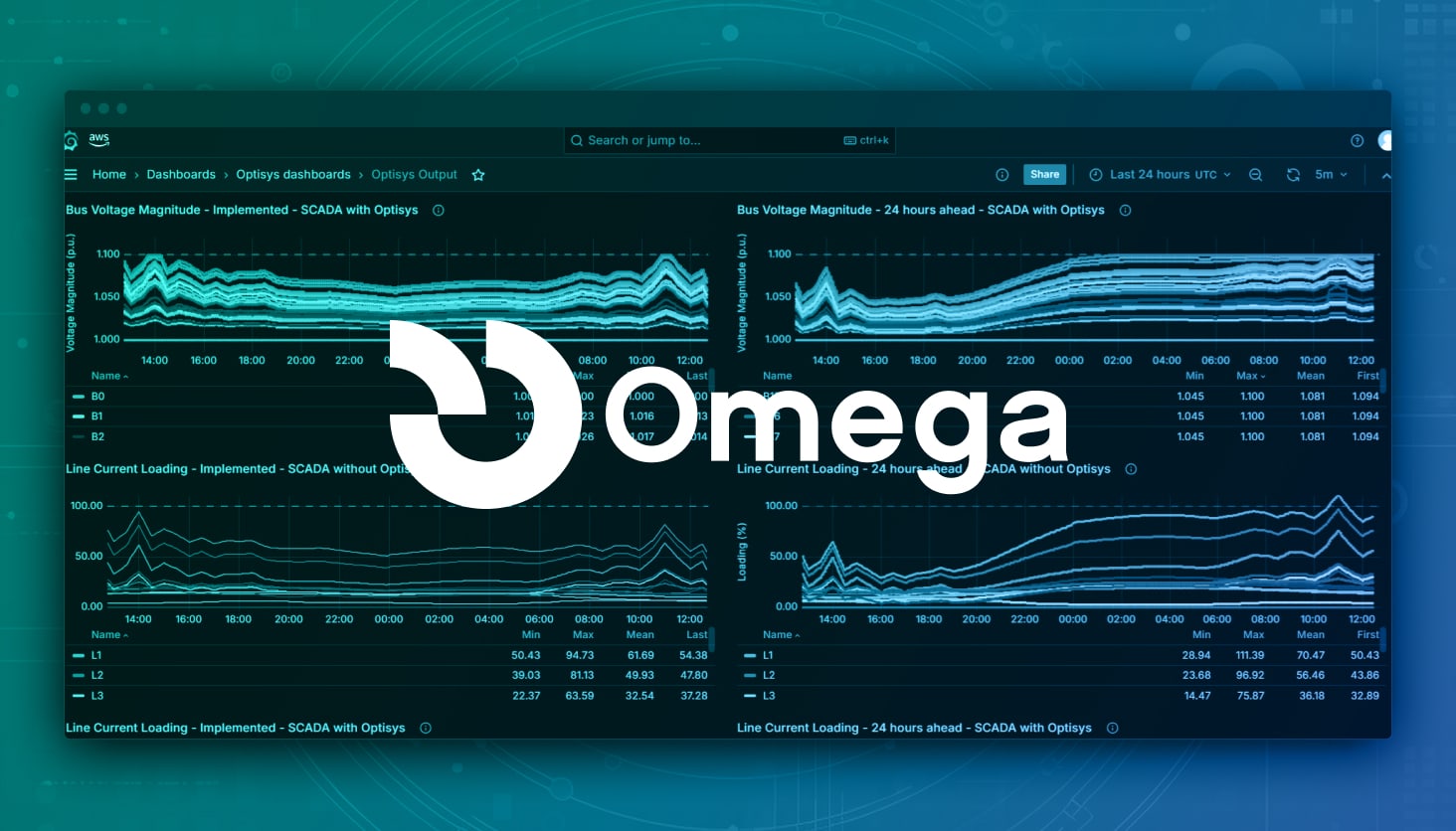
Once telemetry is received (typically after a few execution cycles), the system generates all Grafana dashboards automatically.
These include:
- Real-time DER output
- Feeder-level forecasts
- Net-demand visualisations
- Voltage/load profiles
What makes SMPnet’s deployment different?
Unlike many solutions that require hours (or days) of manual configuration, Omega suite:
- Bootstraps directly from SMPnet’s secure cloud repositories with no pre-installed software.
- Uses a secure, versioned, and signed delivery pipeline
- Ensures deterministic network configuration and secure environment validation
- Prevents unauthorised duplication through hypervisor-level UUID binding
- Has already been deployed in real-world substations and is a proven solution, not a prototype
Benefits beyond the first boot
- Fully operational deployment within a single operational window (< 2.5 hours)
- Completely headless deployment - no UI needed
- Repeatable across environments
- Secure by design: Encrypted credentials, signed containers, and tamper-proof images
- Works with existing hypervisors and IT firewalls
Operational impact
By automating the entire deployment lifecycle, Omega suite enables DSOs to:
- Reduce or eliminate on-site installation visits
- Shorten deployment timelines from days to a single operational window (< 2.5 hours)
- Ensure consistent, policy-compliant rollouts
- Scale digital substations without increasing engineering overhead
- Accelerate time-to-flexibility and operational readiness
The transition from deployment to control is no longer a multi-day engineering effort—it is an automated, repeatable process.
Ready to deploy smarter?
If you're looking to move beyond custom scripts and semi-manual deployment, it’s time to explore what Omega suite’s automation can do. Contact us today.
Watch the full deployment video at the top of this post to see how SMPnet enables grid-edge virtual machines to transition from deployment to operational control within a single operational window.
Related

.jpg)
.jpg)
